|
|
|
Dear readers,
We are back with the spring edition of Secrecy Tracker. I’m Pascal Hansens, a reporter at Investigate Europe, and I wrote this newsletter with the help of Alexander Fanta from Follow the Money, and the EUobserver team. Shout-out to my colleague Ella Joyner for the edits.
On the menu: eerie similarities between a law on data centres and key Big Tech lobby asks, followed by the European Court of Justice’s chaotic website relaunch. For dessert, a closed-door transparency celebration, à la EU.
Off we go!
|
|
|
|
|
|
|
What happens in data centres stays in data centres
Data centres consume electricity voraciously, need millions of litres of water for cooling and pressure strained energy grids. The EU wants to triple data centre capacity within five years to get its slice of the AI boom, and the impacts are being felt all over.
The European Commission collects key data on their environmental impact, but keeps the individual facility-level information it receives closely under wraps.
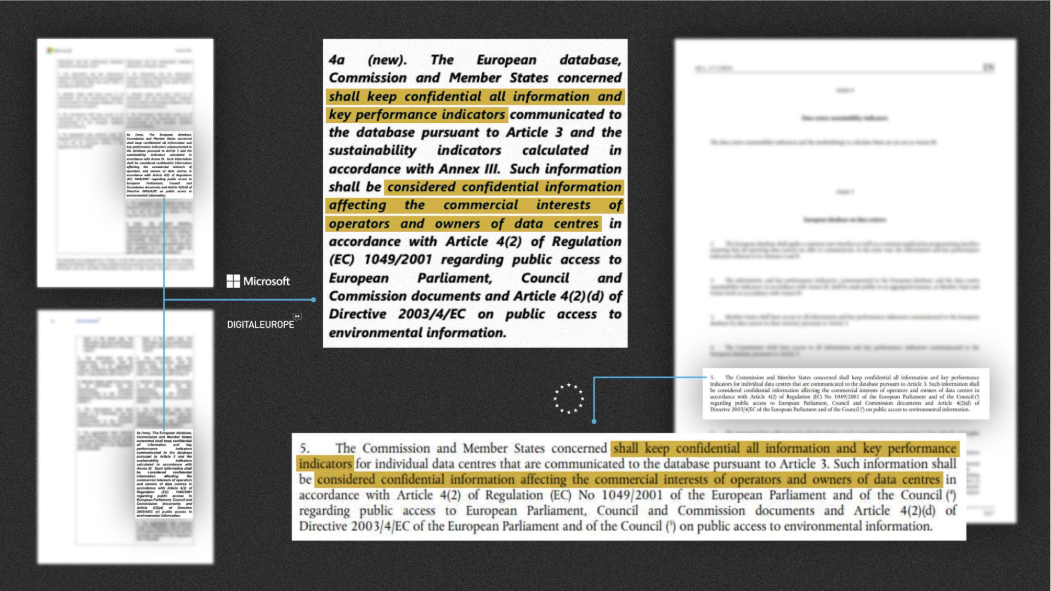
It’s all thanks to a delegated act linked to the Energy Efficiency Directive, adopted in March 2024. Article 5 states that the Commission and member states “shall keep confidential all information and key performance indicators relating to data centres” in line with Article 4 of the access-to-documents regulation - one our readers likely know quite well, setting out grounds for refusal.
That provision did not emerge out of thin air. Microsoft and DigitalEurope (which represents, among others, Amazon, Google, and Meta) submitted an almost identical proposal amendment during the consultation process, Investigate Europe and its media partners revealed earlier this month.
As a result, only aggregated, national-level data is made public, while information about the specific impact of individual data centres remains out of reach. Experts warn this could violate EU transparency rules - in particular the Aarhus Convention, which guarantees citizens access to environmental information.
“We reject the accusation of ad verbatim copy-pasting of industry lobbying,” the Commission told AFP last week, after earlier declining to give Investigate Europe an on-the-record response.
|
 |
Court spends €1 million on re-design ‘disaster’
Lawyers and legal scholars across Europe were left perplexed by a redesign of the European Court of Justice’s case search tool InfoCuria, which went live in January.
While the court described the new InfoCuria interface as “clear, intuitive and user-friendly”, the legal community has been less enthusiastic, with one law professor calling it a “disaster”, as EUobserver reported at the time. Shortly after the launch, the court was forced to re-instate the old “advanced search” function.
Despite its shambolic appearance, the project was not a quick and dirty job, but a years-long project involving a user survey, a study and an audit report, as well as input from dozens of officials. After years of planning, the court commissioned the re-design in May 2025. It spent almost €1.2 million euros on the revamped site using no less than five subcontracting firms, the court’s communications director Arnaud Bohler told Follow the Money.
The court considers the re-design “as a success and a positive achievement, and a large part of the users have welcomed this evolution,” Bohler said. Yet, he acknowledged that “a reduced number but notable part of the users of the InfoCuria search engine – the EU law legal practitioners and academics – have higher expectations.”
The court said it plans to launch an improved version of InfoCuria this spring, while “maintaining the old version in parallel for a transitional period.”
|
|
|
Ombudsman hit with AI-fuelled wave of complaints
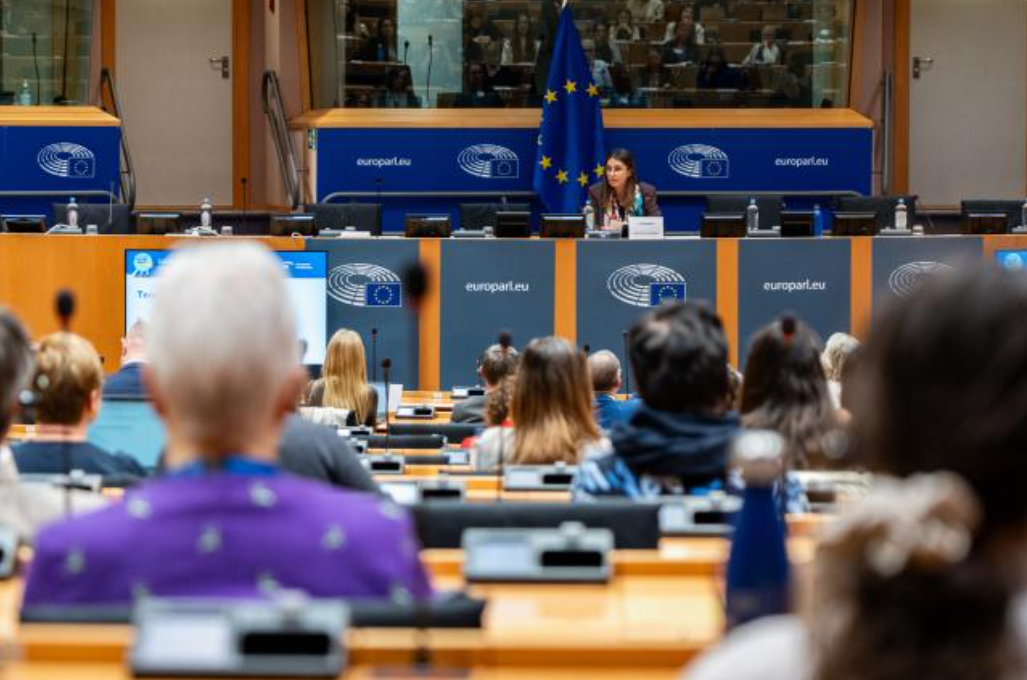
The European Ombudsman, Teresa Anjinho, unveiled a new report exposing a system under strain: complaints have surged by 54% certainly fuelled in part by AI tools flooding the office. This has led to an 86% increase of inadmissible complaints, often due to misguided AI advice, according to the report. But the Ombudsman is fighting fire with fire, developing a pilot project to use the Commission’s in-house AI to improve investigations and case handling “while maintaining its independence and integrity”.
|
 |
|
|
|
|
|
|
|
Secret transparency gathering
In other news, on 5 June the Council of the EU is holding a non-public event at its Brussels headquarters to mark the 25th anniversary of the EU’s transparency law, Regulation 1049/2001. Yes, you heard that right - there’s a closed-door event to celebrate transparency. A classic EU move, one might say. We’ll make sure to file a request for the minutes - which, we suspect, will be marked “LIMITE”.
|
|
|
We need you for our transparency survey
In our previous letter we announced the creation of a new transparency group within the International Press Association to keep an eye on EU institutions’ transparency practices. In order to open a constructive dialogue with the EU institutions, we are currently gathering data on journalists’ experiences regarding the access to documents. Early findings show clear room for improvement, but we need more input. If you regularly cover EU institutions, please contribute by clicking on this link.
If you come across any good examples of EU institutions dealing with transparency (or failing to!), let us know! And stay tuned for our next newsletter.
For any suggestions, examples, or complaints, email hansens@investigate-europe.org, alexander.fanta@ftm.nl or esn@euobserver.com
|
|
|
|
|
|
|